
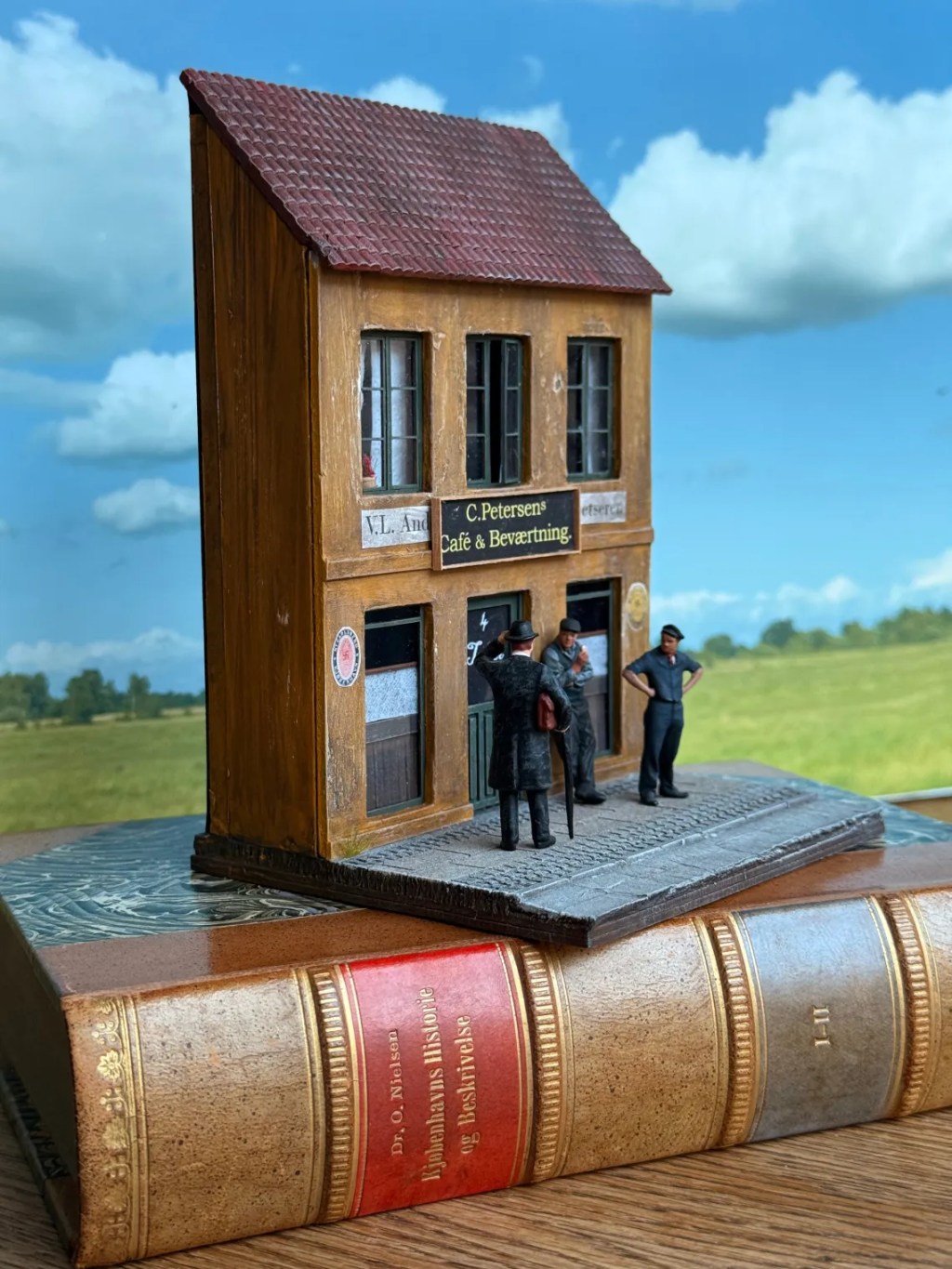
A great reason to work in 0-scale, somewhere around 1:45, is the rich opportunity for scratch-building. That was one of the reasons that I recently convinced me to begin collecting and building in that scale. But I know from experience that it is difficult to build precise and neat in new scales, and that you learn a great deal along the way.
For that reason, I decided to build a small building, both to practice techniques and to gain an understanding of the time required to create something from scratch.
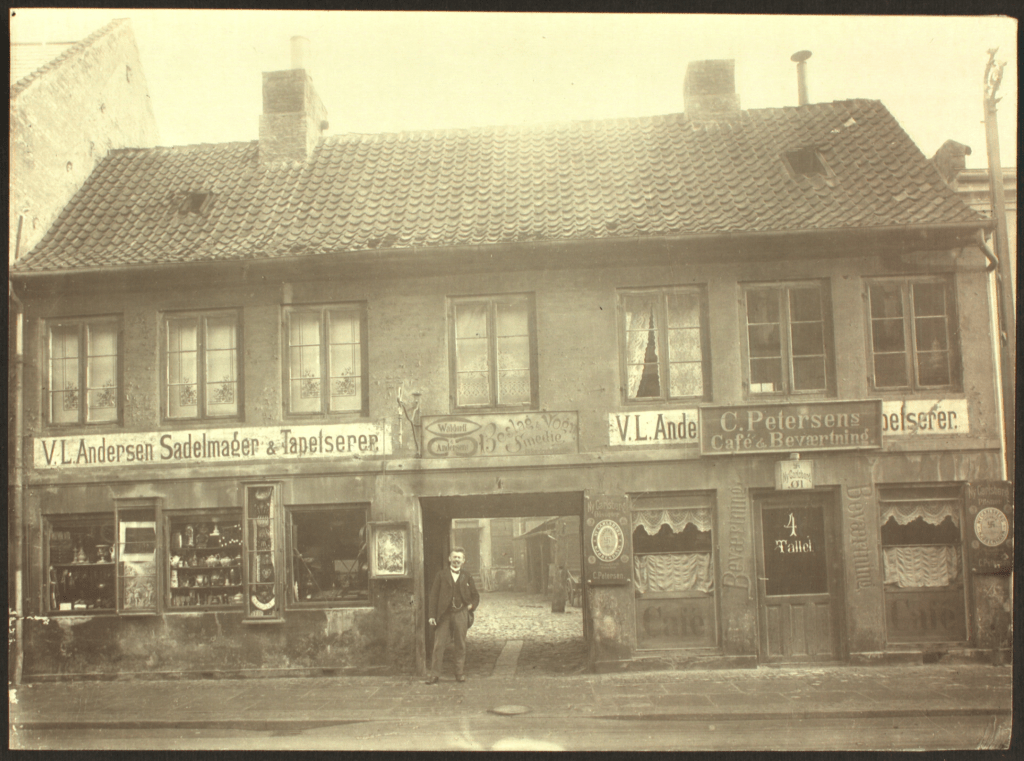
But I needed a prototype, a real place to build from. On the excellent website Kbhbilleder.dk there are currently more than 165,000 digital images of Copenhagen, made available by the Museum of Copenhagen and the municipal archives of Frederiksberg and Copenhagen. I happened to search for the street where I myself grew up – Smallegade – and suddenly came across a wonderful photograph from the early twentieth century.
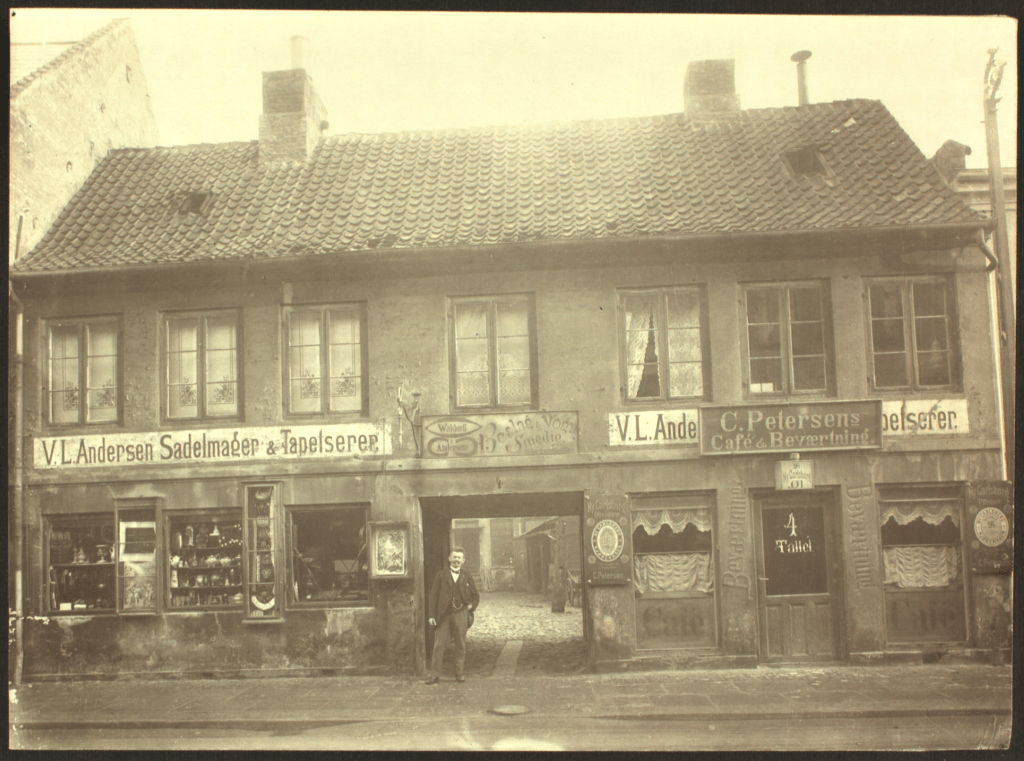
This photograph was taken by the photographer Heinrich Johan Barby, who had his studio on the street of Gammel Kongevej in Copenhagen from 1884 to 1930. Kbhbilleder estimates that the image dates from around 1910, while the Danish Royal Library, which also holds the photograph, believes it is from about 1900.
I was particularly taken with the detail showing pub-owner C. Petersen, who in the shop to the right has simply hung his sign directly on top of the old one, which is probably painted onto the façade. Such oddities are hard to invent yourself, but great fun to copy from a photograph.
I therefore chose to build the three bays on the right as a relief model, that is, with only a front façade. If it turned out well, the model could probably be used as a photographic backdrop for the figures I paint.
I had nothing to work from other than the photograph as the building was now long gone, so the first task was to determine roughly how large the building had been.
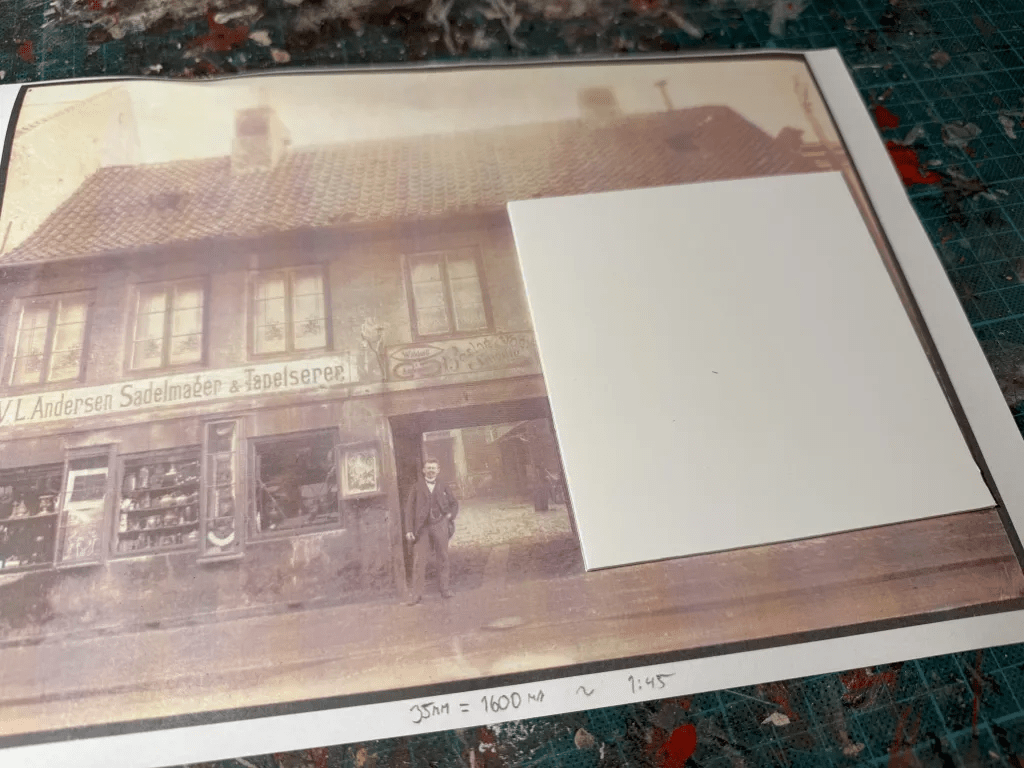
I printed the image in A4 format and began measuring, using the man standing in the gateway as a reference. I judged him to be relatively short, perhaps around 165 cm tall, based on the poor nutrition common in the early 1900s. Quite remarkably, this meant that my print was more or less in 1:45 scale, allowing me to build directly from the photograph.
In the image, I have placed a piece of foam board directly on top of the print in order to capture the size of the façade.
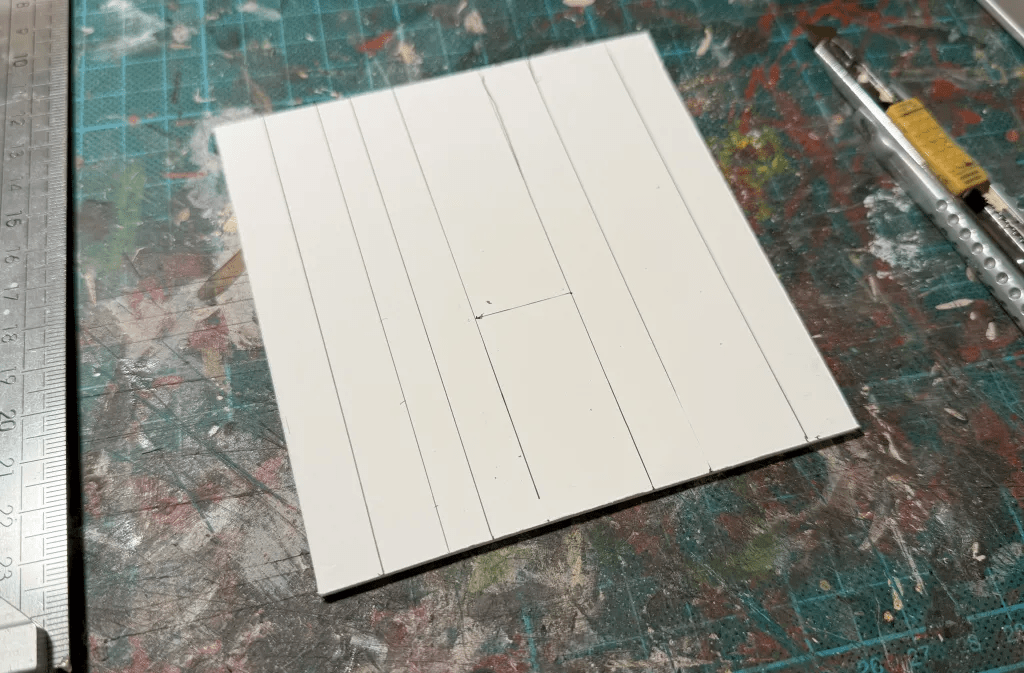
I then drew in the windows and doors as accurately as I could, after which I could begin cutting. I chose thin foam board for the façade because it is reasonably rigid and very easy to cut.
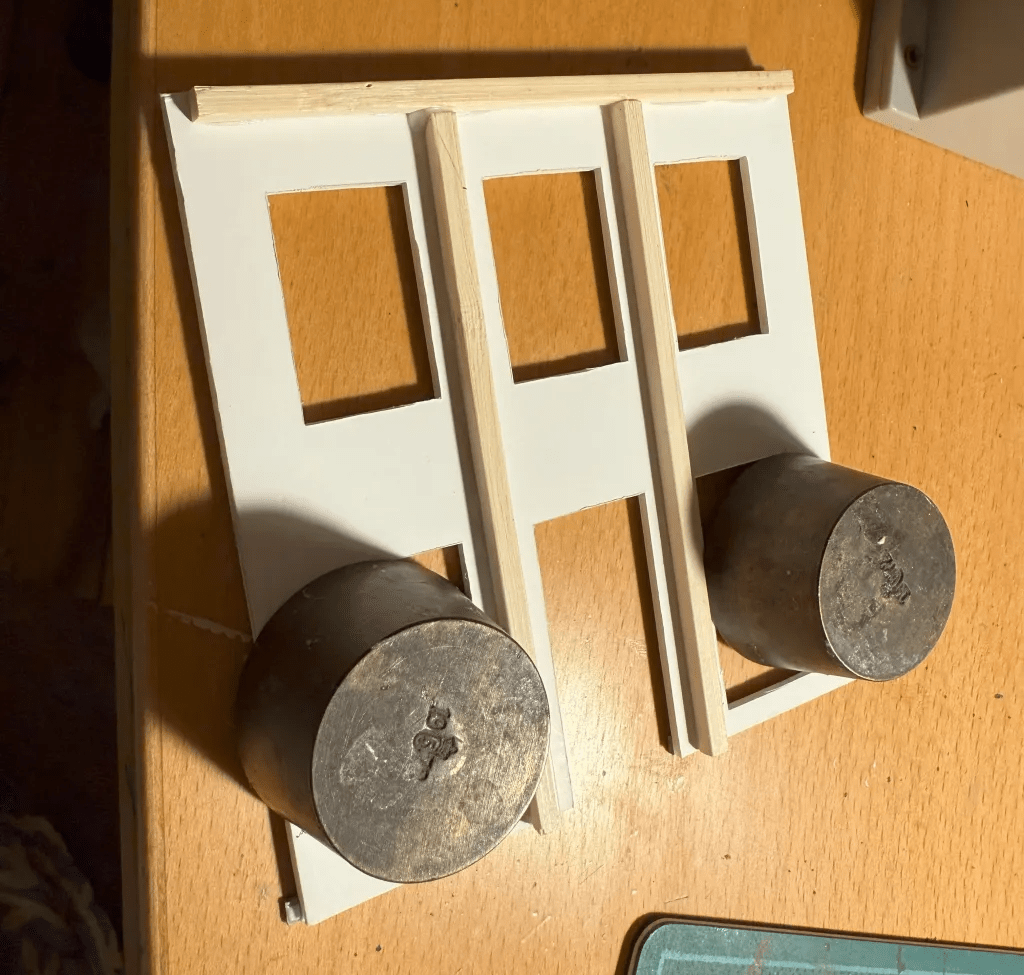
Even so, I was concerned that the foam board might warp, especially once I started painting it. Therefore, I glued wooden strips to the back and weighted the façade down while the glue dried.
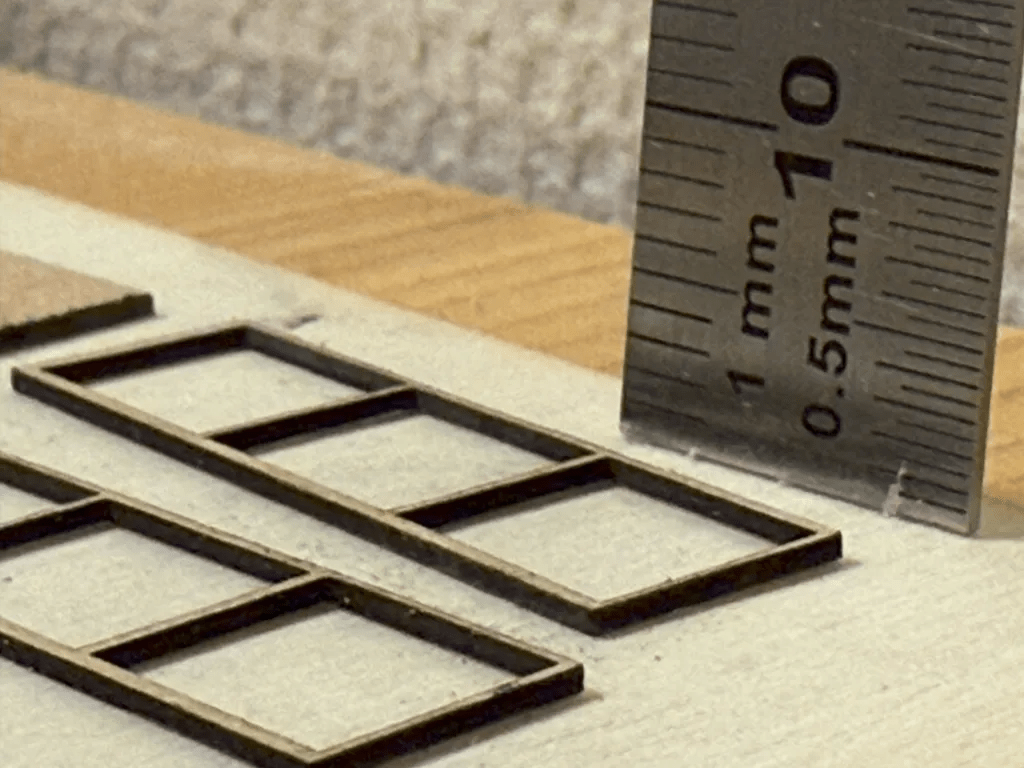
The next step was to create windows and doors for the building. I cannot cut these satisfactorily by hand, so this was a good opportunity to use my laser cutter, which is a lot of fun.
Drawing in 2D is quick, so that part was easy. The material for the windows and door is 0.75 mm brown card—an excellent and inexpensive material that is surprisingly rigid.
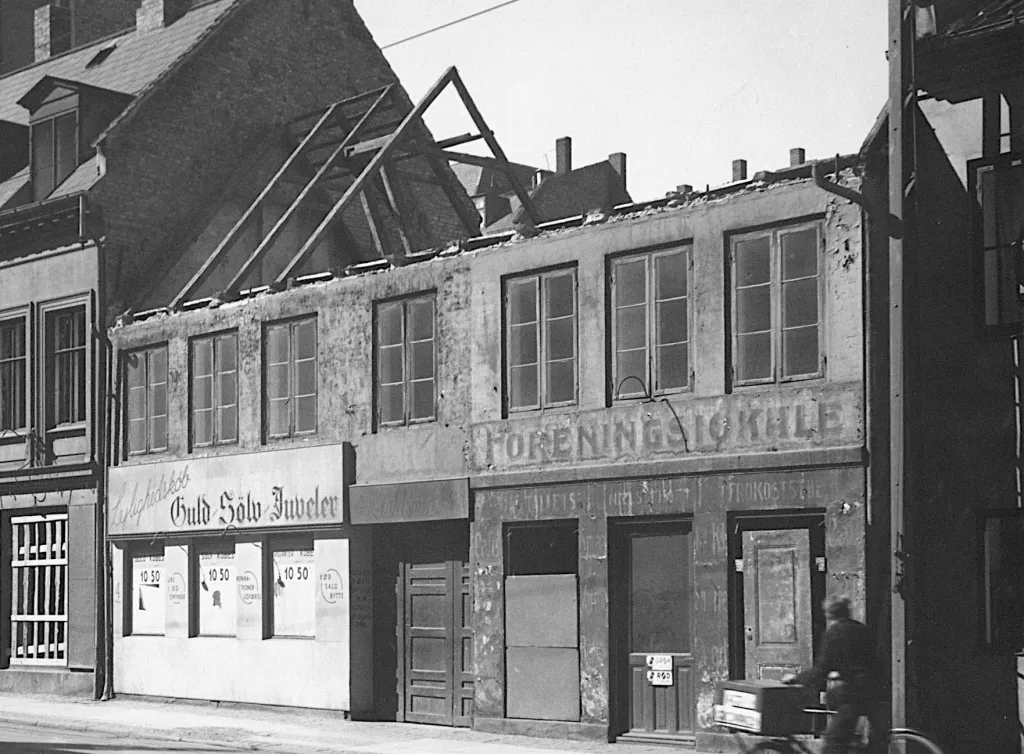
In the photograph above of Smallegade 4, taken by Carl Ernst Hannuss in 1938 when the house was demolished, one gets a good impression of the masonry and the windows. Note how the windows are almost flush with the façade, and how simple and shallow they are.
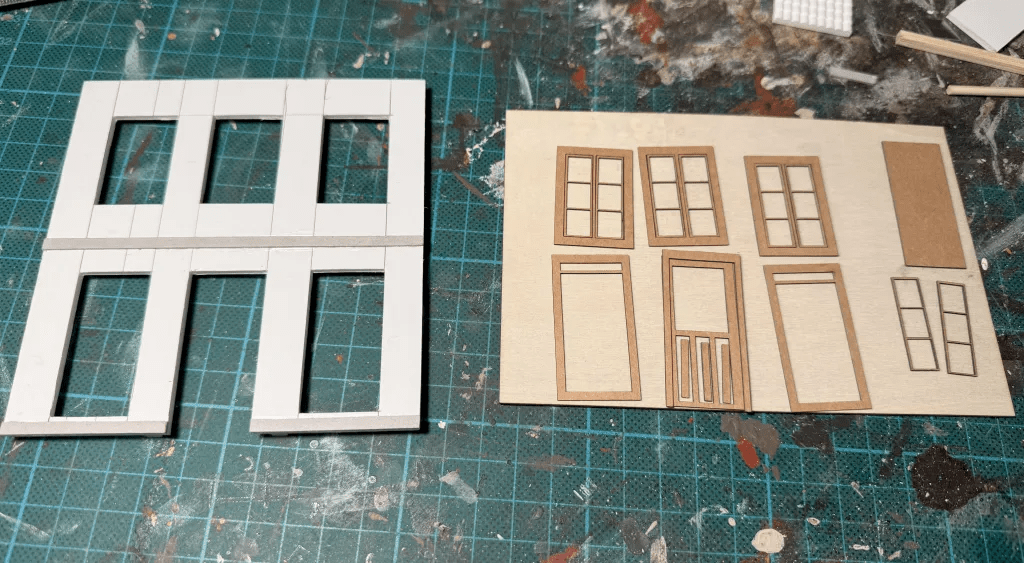
This made it easy to cut the windows as a single layer with separate frames that can be opened. The door was given a bit more depth using three layers, which I glued together.
After gluing a few decorative mouldings onto the façade, I first painted it a sandy colour, adding a little plaster to the paint to give it some texture. Then I painted it ochre yellow, followed by several washes. Along the way, I sanded the façade with fine sandpaper to bring out the underlying colours and to make the plaster appear worn and dirty. I mostly used a wash of little grey-brown paint, lots of water, and a drop of dish soap to help the wash flow more easily.
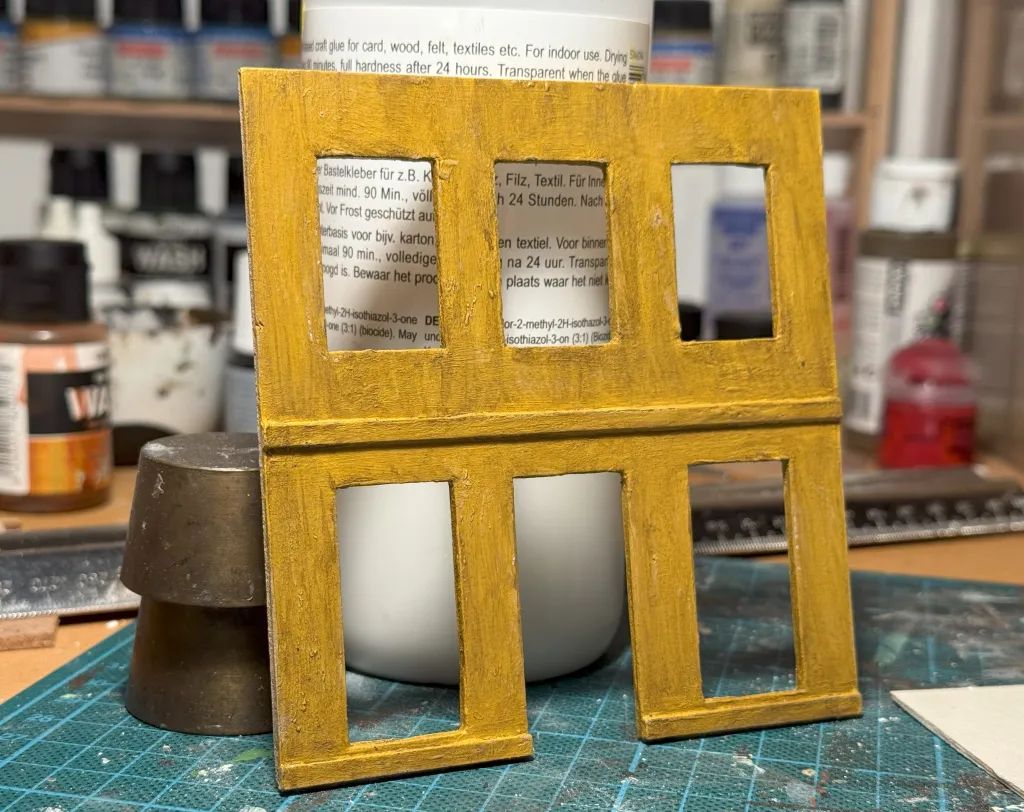
After all these layers and sanding, it looked like this and began to resemble the worn, plastered walls I remember from my childhood in the impoverished Copenhagen of the 1980s.
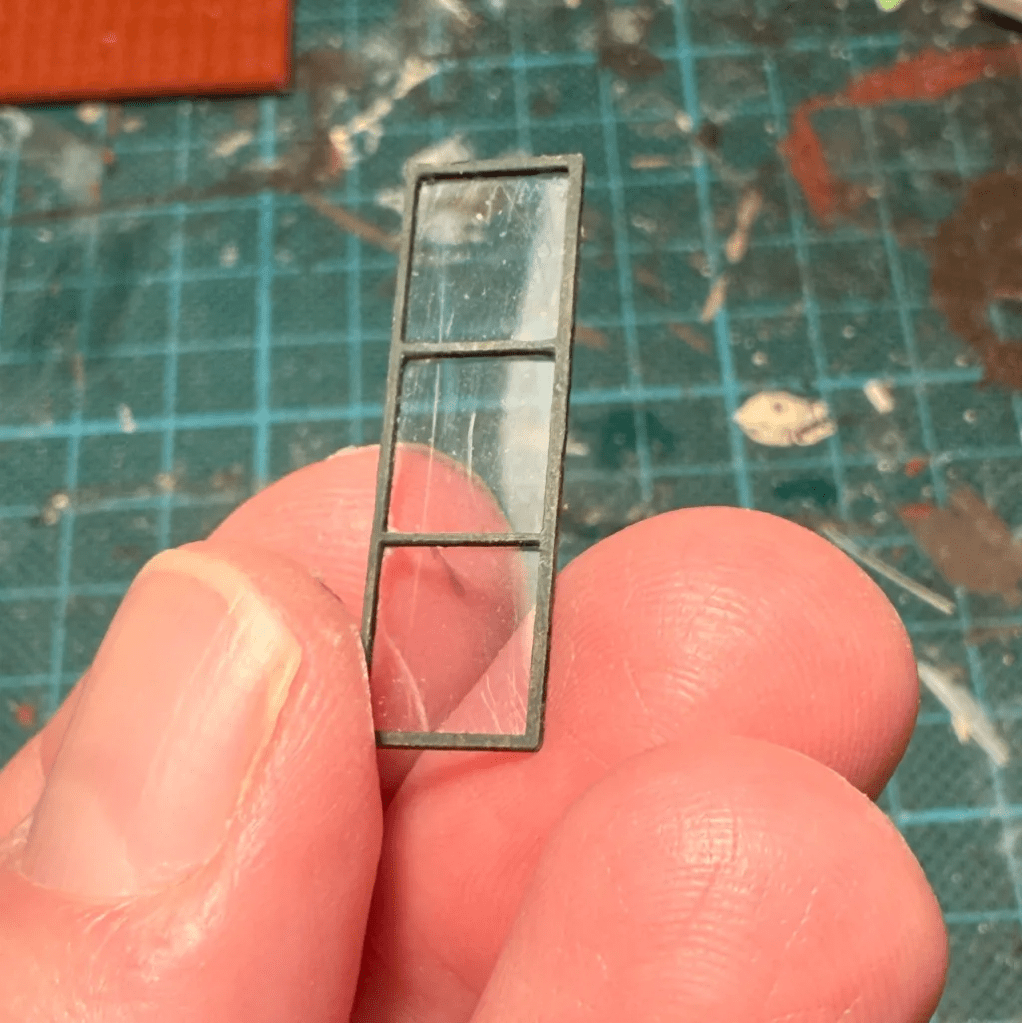
I painted the windows green and cut some acrylic sheet to represent window glass.
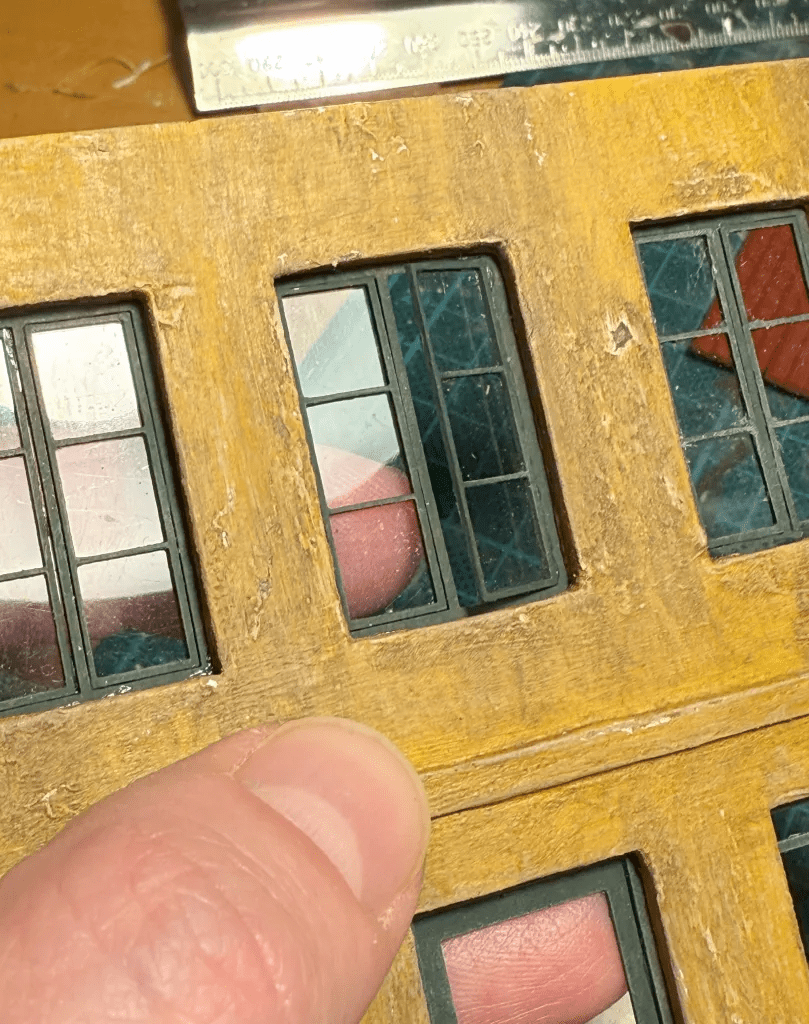
I wanted to leave one of the windows slightly open to give the façade a bit more depth, and fortunately it was easy to glue the laser-cut frames in place.
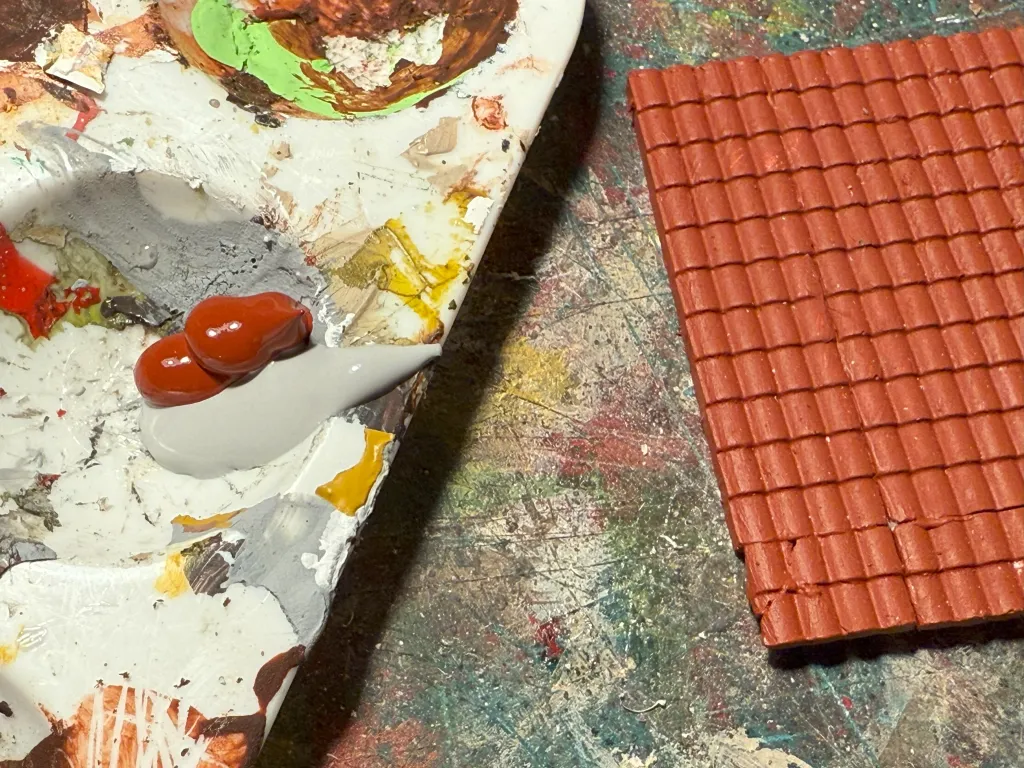
Then it was time for the roof. Some time ago I had bought moulds for casting tile roofs in scale 0, so I cast some panels in plaster and glued them together. Normally I simply paint them a tile colour, but this time I mixed brick red with neutral grey in equal parts, which produced a nicely subdued base for later weathering.
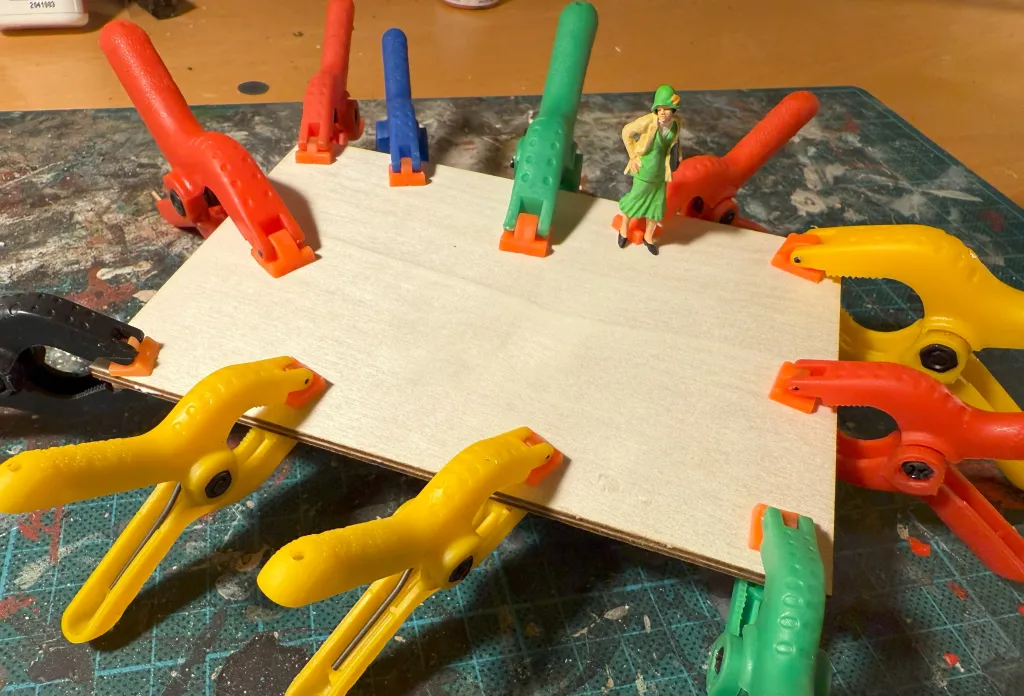
While that was drying, I made a base for the relief house and a small section of pavement in front. I have bought quite a few wooden strips and plywood sheets on Temu, where prices are very different from what one pays in Europe. The quality can be inconsistent, but I have generally been lucky.
For the base, I glued two plywood sheets together to create an even stiffer sandwich, and made sure to keep it under pressure while drying.
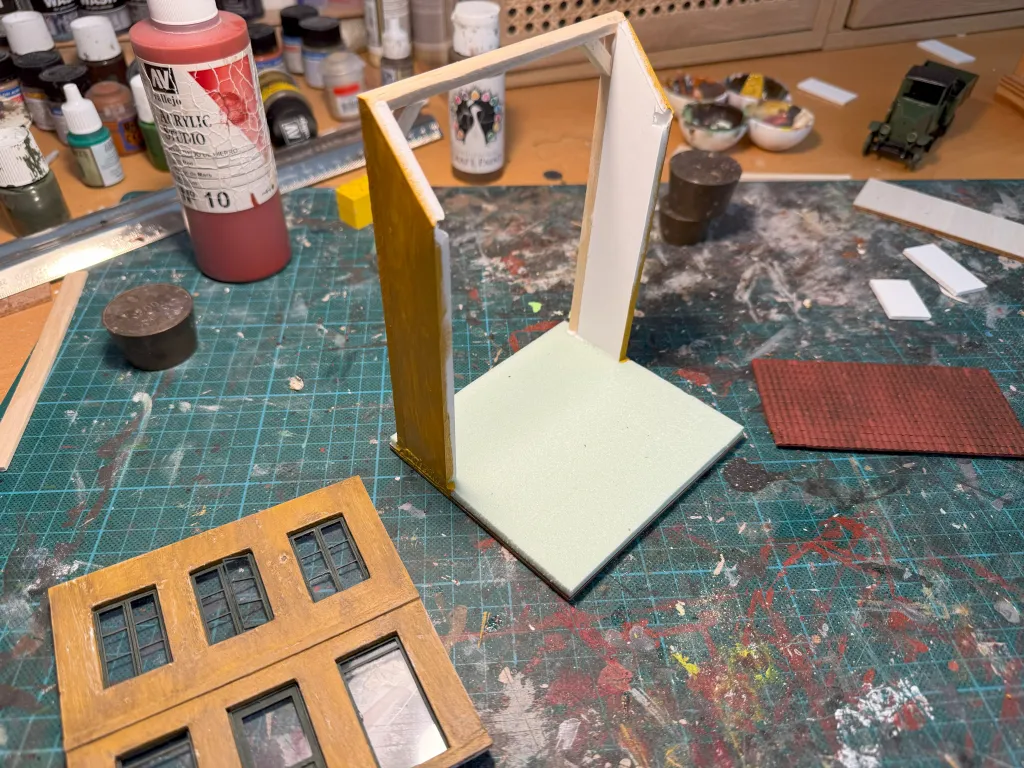
On top of the board I glued a thin layer of XPS foam, which is excellent for engraving, allowing me to create the paving stones.
Up to this point I had not thought much beyond façade and roof, but some small side walls were necessary, and in order to support the fairly heavy plaster roof I built a wooden frame to carry it.
Before gluing the façade in place, I engraved the cobblestones. I did forget the kerbstones, however, so I made those from small pieces of wood instead. I had initially assumed that the pavement followed the usual Copenhagen pattern, with cobblestones in the middle and paving slabs on either side, but that did not match the historical photographs, so I tried to imitate what I could see there.
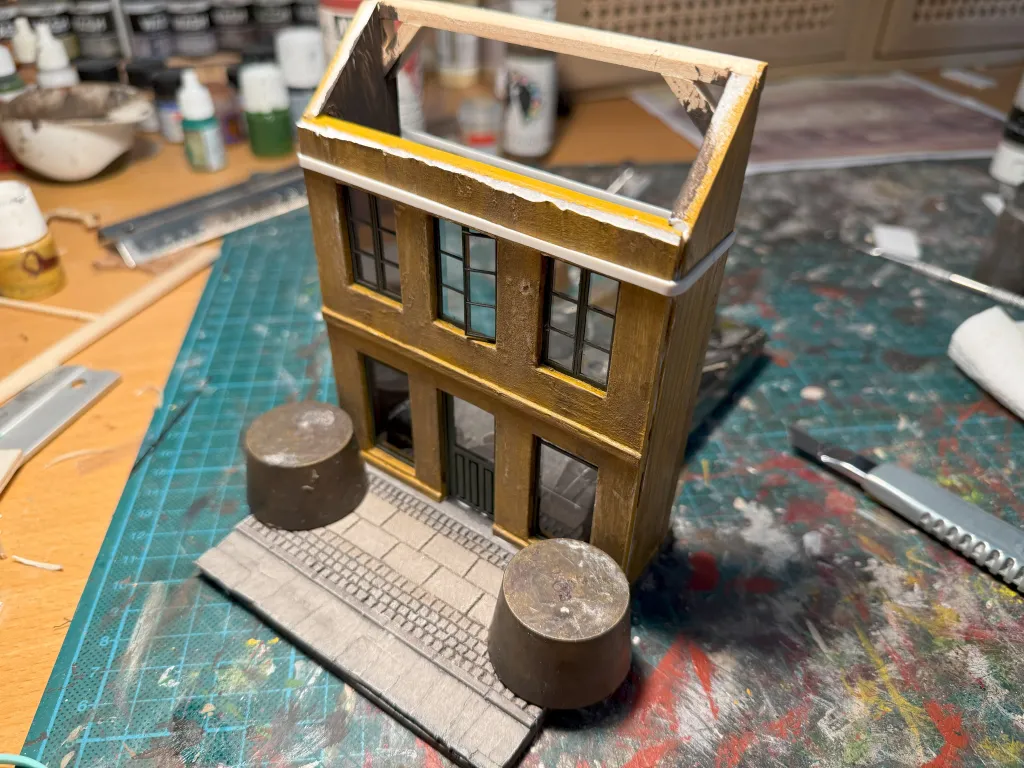
After painting and weathering the street section, I glued the façade in place, and suddenly it began to look like a real house! It is a delightful feeling to see a building emerge from foam board, wood, and card 🙂
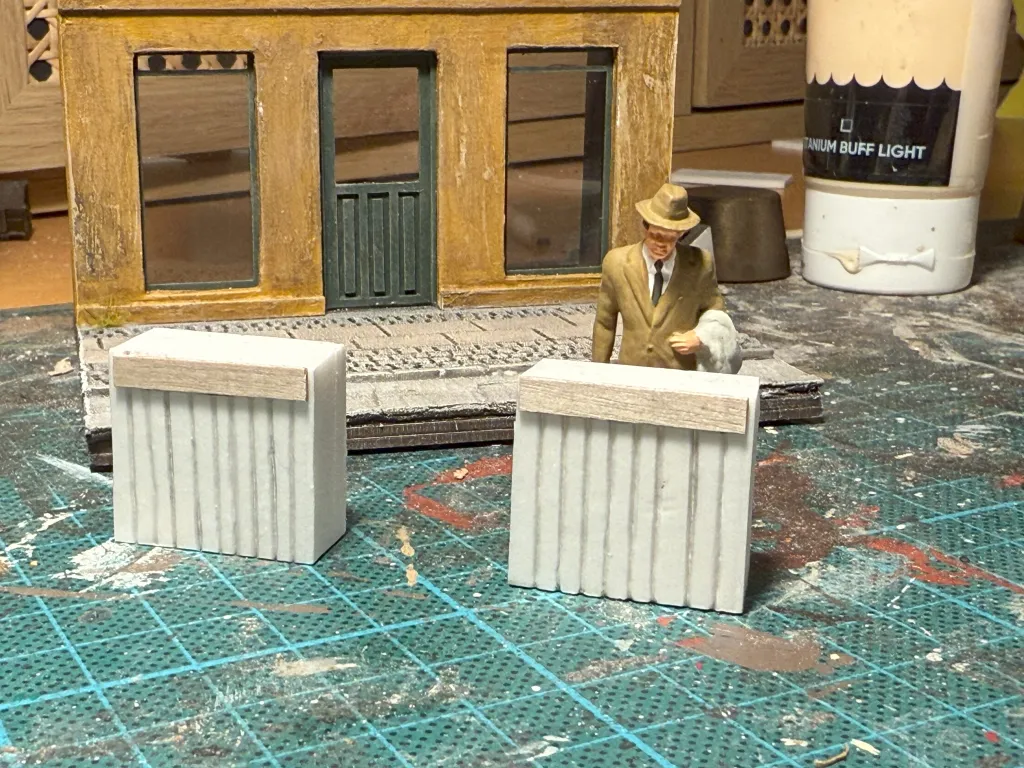
In the old photograph of Smallegade 4 I could see that the pub had some kind of wooden panelling in the right-hand windows. I am not entirely sure what it was, but I replicated it using small pieces of XPS foam, engraving the panels and adding a wooden strip along the top.
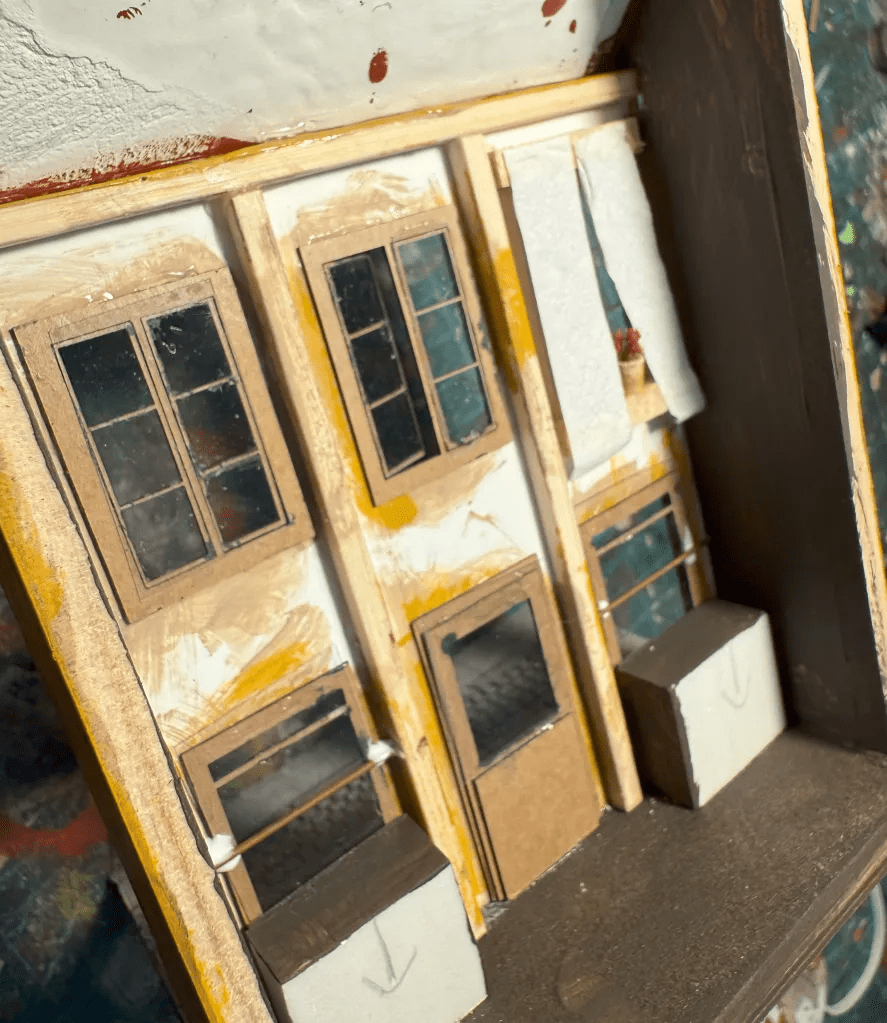
After painting and weathering, I glued them in place, at the same time creating a windowsill with a potted plant and curtains on the first floor.
The curtains are made from single layers of paper tissue.
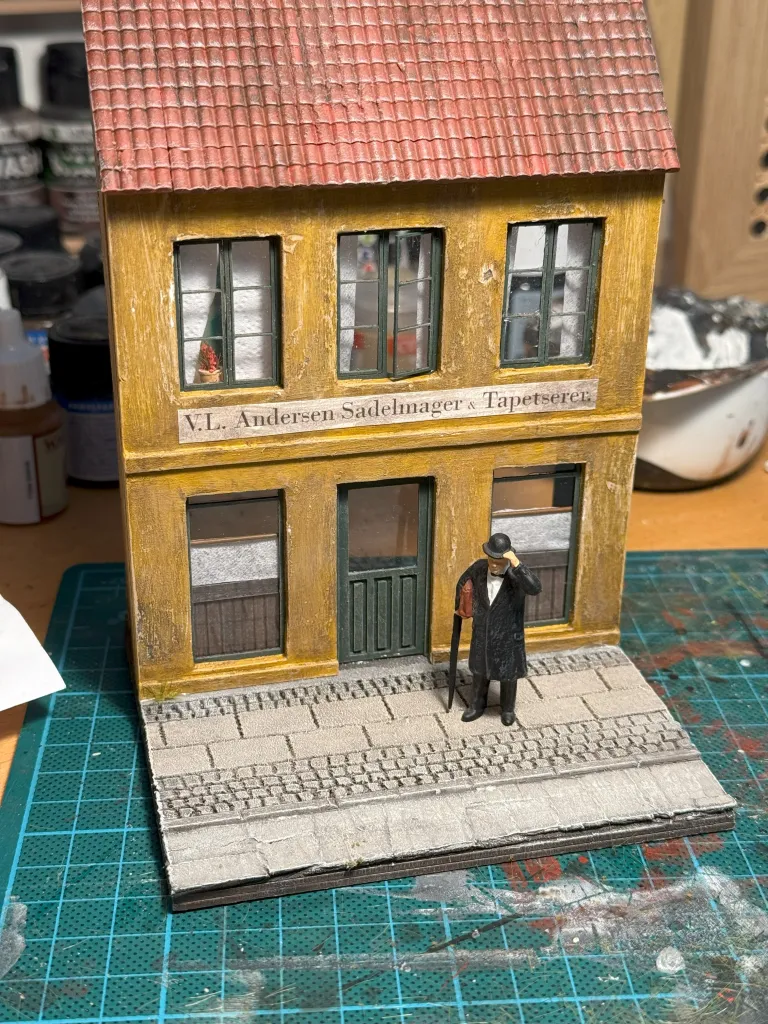
Then it was time for the signs from the old photo. I first tried to match the lettering on the innermost sign on the building, but it is extremely difficult to find typefaces that resemble the work of the old sign painters.
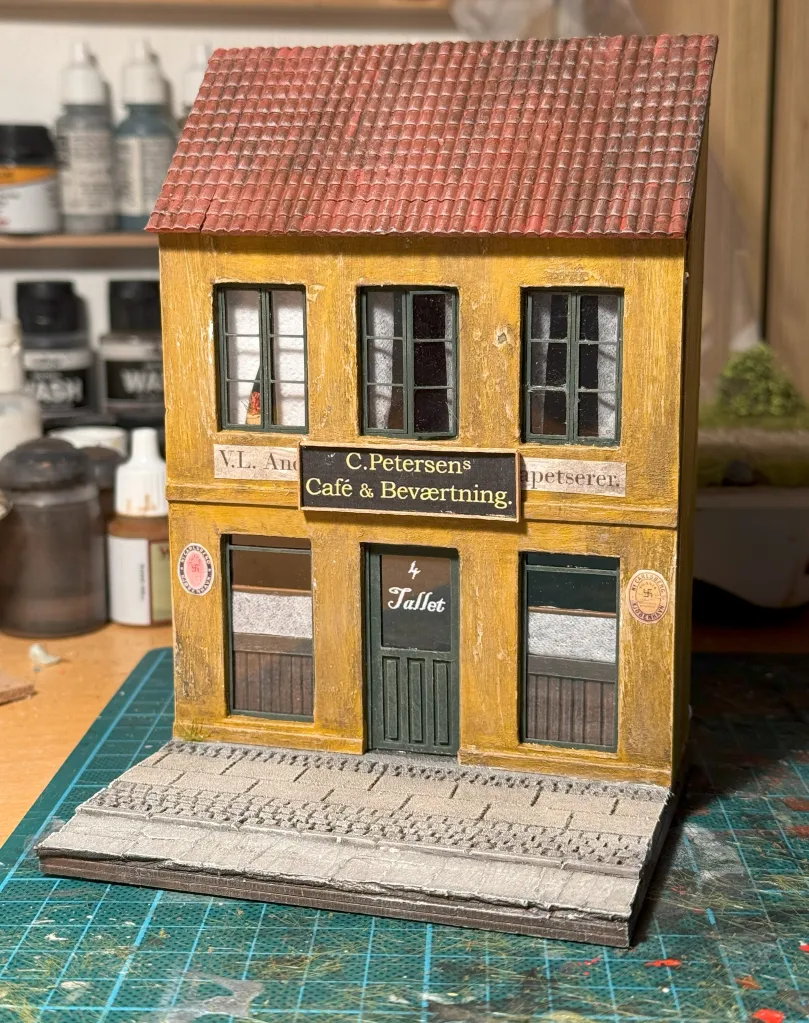
The tavern sign got a wooden frame just like in the photograph and was glued on top of the old sign. Online I was able to find the same beer advertisements as those visible in the photograph, and the name of the tavern on the door was printed on a black background and glued behind the glass.
I could have gone on much longer with the multitude of signs lingering in the photograph, but chose to stop here.
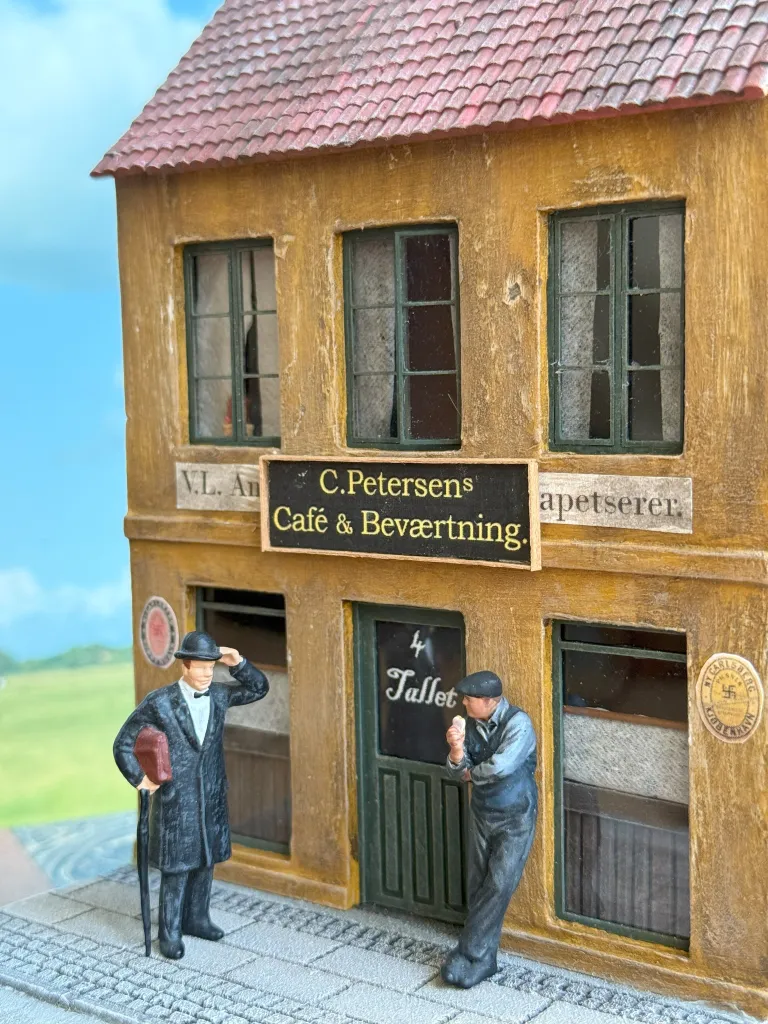
For now, the building can serve as a photographic backdrop for figures, although close-ups mercilessly reveal everything that could have been done more neatly.
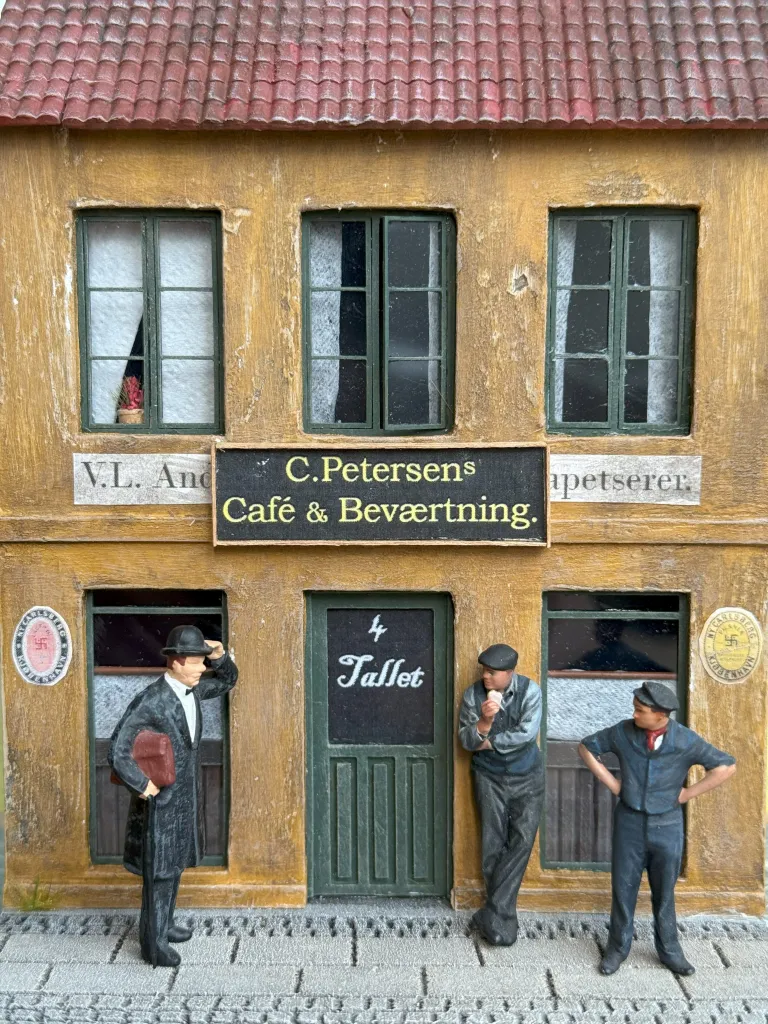
Hmm, perhaps a gutter would improve it? And maybe some more weeds? And what else? 🙂
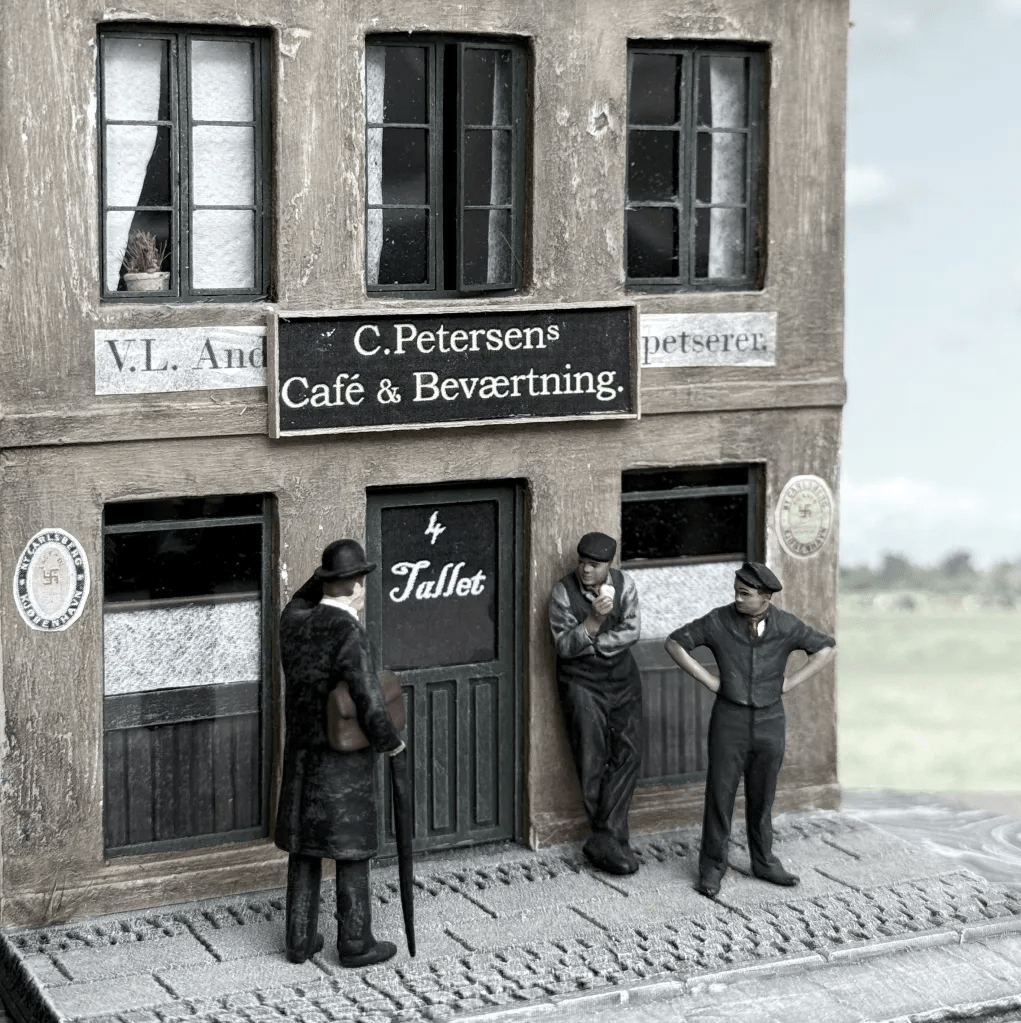
But one must stop somewhere, and I have already learned a great deal from the build. For example, I would clearly prefer to laser-cut the façade for greater precision. Cutting ovals, such as those on the beer advertisements from around 1900, is harder than it looks once the camera gets close.
Next I will plan the full house, and perhaps make it as a kind of kit with walls, windows, doors, and signs. It would be fun if multiple versions of the old house from Smallegade 4 in Copenhagen were suddenly to appear around the world 🙂
Thank you for following along this far!
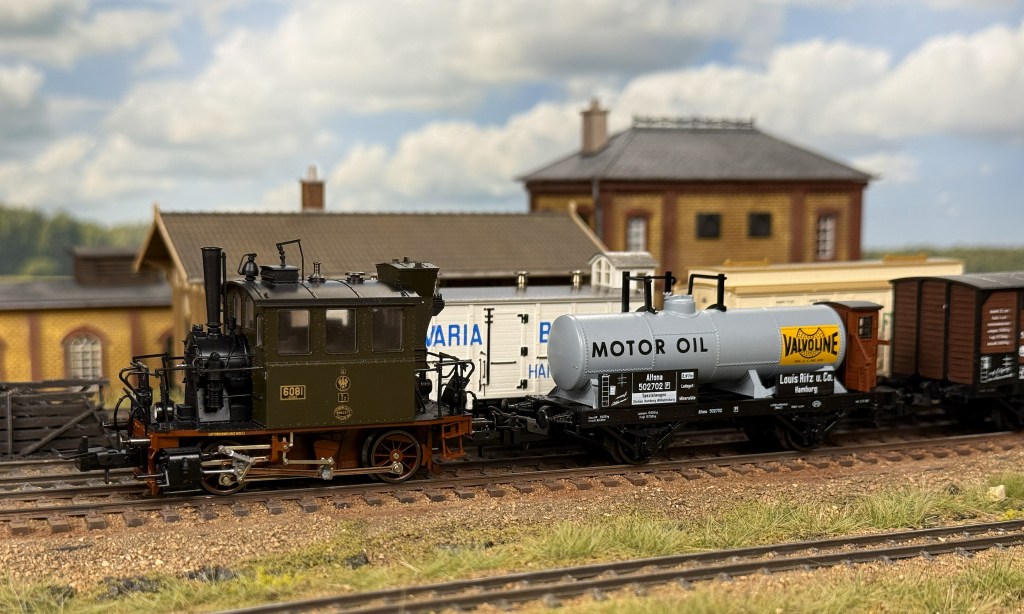
 Epoch 1
Leave a comment